

KOSET TALAVERA

Updated: Aug 30
performer

Koset Talavera describes their practice as antidisciplinary, understanding arts as mycelial process. Born in Gran Canaria, they move fluidly between theatre, dance, performance, visual art, and collective practices as a deliberate refusal to let any single discipline close the question down. Their website describes them as "crossed by hybrid trans-antidisciplinarity." In conversation, they put it more simply: they are interested in the third space. The thing that exists between you and me, between outside and inside, between object and body, between what can be named and what can only be felt.
Koset studied drama at the Escuela de Actores de Canarias and later completed a Master's in Stage Creation at UC3M in Madrid, directed by playwright Juan Mayorga. The master's was revelatory: thirteen people of different ages and backgrounds -but deeply interested in diverse theatre perspectives-focused not on whether they liked each other's work but on how to understand it. The academy that came before had been something else entirely: competitive, hierarchical, exhausting. A system that trained you to be a puppet, as they put it, rather than an artist. They graduated with distinction anyway and promptly decided they couldn't follow instructions from someone they couldn't connect with; rather than that they preferred to find their own poetics. The solo trajectory that followed was difficult and uncertain, but necessary.

What has emerged from that solitude, and from the community they have since found, is a practice that grows outward like mycelium, and the image is theirs. Their first creative instinct tends to be visual or conceptual: images that arrive in the hypnagogic space just before sleep, which they learned to catch by writing the moment they woke. Surrealist automatic writing is another tool they return to. So is the daily self-portrait drawn with closed eyes, tracing how the body feels rather than how it looks. These are not warm-up exercises. They are the research from daily life.
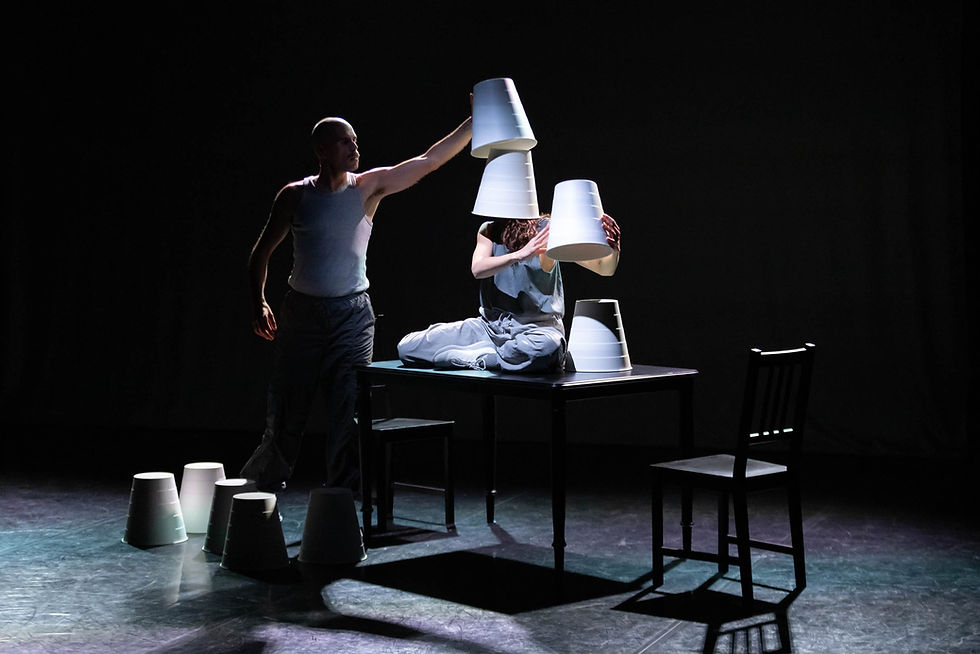
In 2024, Koset co-founded La Sísmica, a physical performance company working at the intersection of bodies and objects, alongside the canarian artist Yiyo Ramírez, a local known

clown. Their current practice emerged from a shared curiosity to enter in the other's logics, as well as how objects refuse to be static, how a chair moved in sync with a body becomes something else entirely, charged with friction and relationality, and what Koset calls the erotic in the broadest sense. Not sexuality narrowly, but the inherent aliveness of things that are always in relation. The second piece in development is intended for the streets: more disruptive, they lose one's cool by breaking bureaucratic office's logics and pulling the audience directly into the disorder of routine. This piece is not yet done but dreamt.
Alongside La Sísmica, Koset moves between Barcelona and Berlin to work with Normies Study Group, a research and performance collective investigating intimacy, sexuality and the body through five-day intensive residencies with open participation. Past editions have worked through themes of 'objectification', 'dirt', 'vanilla' or 'entanglement' (among others), each one a structured experiment in going to the limit in order to understand where the limit is.
More recently, their work has moved toward the documentary and the archival, specifically, toward the intimate and hidden archive of maternal and grandmotherly memory. Memories of memories, the things that weren't spoken about, fragments of rural life and female experience passed down obliquely or not at all. Their surname 'Talavera' reflects this too. They carry both their mother's and grandmother's surnames, a deliberate act of matrilineal naming in a culture that defaults to erasing them. They have also received some European support from fundings such as Culture Moves Europe grant or Moving Matters' project, for this project called: SH! Silent Heritage, a work drawing on the unspoken material that threads through so much of their practice across time.

On the question of how political themes enter their work, Koset is characteristically precise: they don't impose a political frame, but they don't pretend the body is neutral either. The body is already political before it does anything. For example when a body is read as female, queer or dissident and appears naked on a stage, a whole set of inherited assumptions activate in the room. Assumptions the artist didn't create and may not share, but cannot entirely control. Rather than fight this or ignore it, Koset tends to work with it, opening enough space in the performance that the audience brings their own story to fill it. Sometimes, after shows, people come and tell them things. The things they say are not only what happened on stage, but they are exactly what the audience needed to find. That generosity and the willingness to let go of control over meaning, is part of what makes their practice open towards subjectified experience.
Nowadays they're starting a new performative project with the artist Gara Hernández, named "This is not a Body", and that will be presented as an open stage research in Norway, Madeira and Festival Boreal (Tenerife) in 2026.
Creation, for Koset, is not about producing a finished object. It is about generating a situation: a question, a displacement, a moment of contact between a body, a space and whoever is present. Whatever emerges is always partly the audience's. That's the point.


Comments